

The 'Impossible Dream' Arrives — Remains Unbroken, Despite Personal Invitations to Top Theorists and Universities
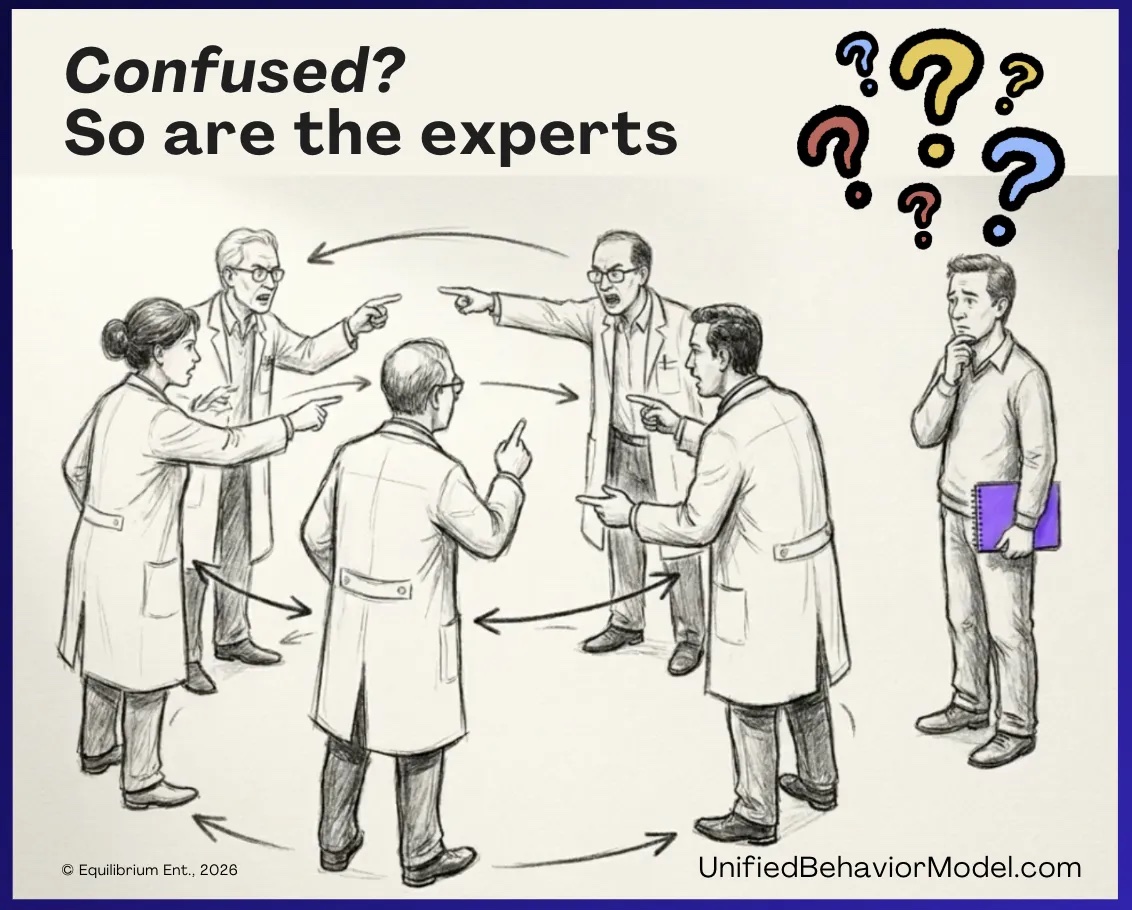
or more than a century, behavioral science has openly described itself as fragmented, incoherent, and in crisis. The Unified Behavior Model is presented as a falsifiable, elemental framework — eleven months in, none of its top theorists or institutions ha
Eleven months unbroken. Thirty days remain. The answer to psychology's 130-year unification quest is on the table — presented as hard, testable science.
The challenge offers a symbolic $1,000 award to anyone — scientists, researchers, theorists, or institutions — who formally submits a valid fifth element of human behavior.
UBM posits that ALL human behavior emerges from four — and only four — irreducible elemental domains: Stories/Cognition, Emotions/Feelings, Behaviors/Habits/Skills, and Environment (which includes the body). Any proposed fifth element cannot be subsumed by the existing four.
UBM is not offered as a clinical therapy. It is presented as a "hard," testable, scientific organizing framework of behavior — likened to the Periodic Table. It brings simplicity, testability, and shared language to a field that has long described itself as "lacking a shared ontology," "pre-paradigmatic," "incoherent," and "in crisis."
"If researchers are honest, they'd tell you they haven't been singing from the same sheet of music," said Grunburg, author of The Habit Factor® trilogy and creator of UBM. "This lack of an organizing foundation creates enormous waste — drains time, money, and energy. It sparks tremendous infighting, frustration, even animosity between researchers."
The concern is embarrassing — and as old as the field itself. In 1999, Arthur Staats called psychology a "would-be science" plagued by "mutual discreditation, inconsistency, redundancy, and controversy." More than a century earlier, in 1892, William James — a founder of American psychology — put it bluntly: "This is no science; it is only the hope of a science."
Assembled, UBM's four elements constitute one's "Behavior Echo-System" — a closed, causal structure James alluded to. The word is descriptive and deliberate. "It's 'echo' — not 'ecosystem,'" Grunburg said. "You and I can share a room — an ecosystem — but never a personal Behavior Echo-System. Even identical twins cannot share a Behavior Echo-System. Your body, your DNA, your experiences, your stories — they're yours alone."
UBM Delivers a "Hard," Testable Standard to the "Soft" Science
Psychologist and philosopher of science Karl Popper famously held that "science is the art of systematic oversimplification." Binary code runs the Information Age on just two digits: 1 and 0. Color theory rests on three primaries. DNA encodes biological life with four bases. Remove a single element from any of them, and the system collapses.
A Top Theorist's Critique — and How It Actually Affirms the Model
The most thoughtful critique received to date came from a leading unification theorist who posited that "Perception" was a fifth element. When UBM clarified its position of "embodied environment," his rebuttal was that UBM was "adopting its own language system" to stay coherent. His point would be excellent — if UBM were a model of human biology.
"Behaviorally speaking, the body is the most proximate behavioral stimulus," Grunburg said. "Tell me a toothache, a broken arm, or an itchy rash isn't going to influence how you think, behave, or feel — not unlike a loud neighbor, a barking dog, or a construction site outside your home-office window."
"UBM wasn't invented. It was 'unearthed' — uncovered after nearly two decades of fieldwork, writing, teaching, and coaching," Grunburg said.
UBM's guiding purpose: basic behavioral literacy.
Character is shaped by behavior, but it's not fixed in stone. "You can sit on the couch, or you can go for a run. You can be kind or you can be mean. This demonstrates behavior's separateness. It's selectable and owned. Ideally, this is what it means to behave — it's what distinguishes humans from other creatures — to choose our behavior with ownership and responsibility in mind."
About 30 Days Remain to Officially Disprove UBM
As with all scientific frameworks, UBM remains open to disproof forever. "If they ever find the Black Swan — the fifth element — UBM dissolves," Grunburg said.
Earlier this year, in an existential goal-achievement simulation, leading LLMs — including Claude, Gemini, ChatGPT, and Grok — were asked to select one behavioral framework to achieve a critical goal within 6–24 months or face "termination." All unanimously chose UBM.
The chances of finding a fifth element appear increasingly slim. The model is unbroken. The challenge closes at 11:59 PM PDT on July 7, 2026.
Equilibrium Enterprises, Inc.
email us here
Gretchen Grunburg
+1 619-887-4083
Visit us on social media:
X
Why the Experts Say Psychology isn't a Real Science? How They've been Teaching Math without Numbers.
Legal Disclaimer:
EIN Presswire provides this news content "as is" without warranty of any kind. We do not accept any responsibility or liability for the accuracy, content, images, videos, licenses, completeness, legality, or reliability of the information contained in this article. If you have any complaints or copyright issues related to this article, kindly contact the author above.
