

GoodVision AI Introduces the “7-Layer AI Cake” Framework for the Inference Era
California, San Francisco , June 02, 2026 (GLOBE NEWSWIRE) -- GoodVision AI has introduced what it calls the “7-Layer AI Cake” framework, outlining how the company believes the AI industry will evolve as global infrastructure shifts from a model-centric era toward a token-driven economy.
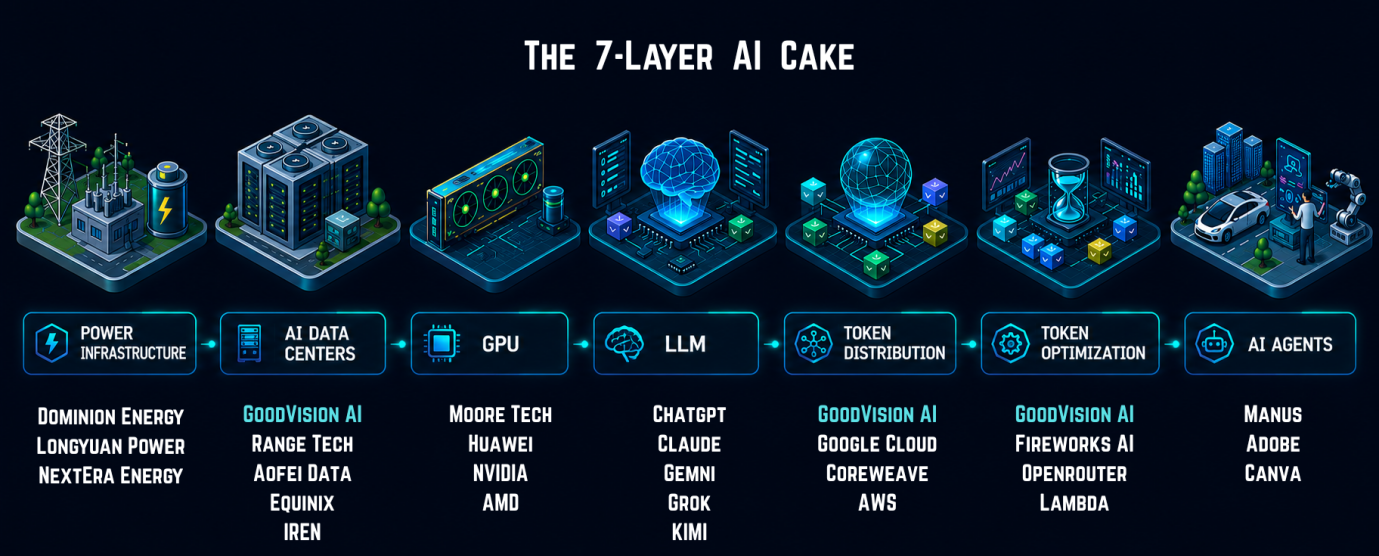
According to the company, the future AI stack will consist of seven interconnected infrastructure layers:
- Power Infrastructure
- AIDC (AI Data Centers)
- GPUs
- Large Language Models (LLMs)
- Token Distribution Networks
- Intelligent Scheduling Systems
- AI Agents
GoodVision AI argues that AI is evolving into a large-scale “token industrial system,” where the ability to generate, distribute, orchestrate, and optimize tokens efficiently may become more important than model size alone.
The company said the framework was developed in response to the rapid expansion of AI inference workloads, as AI agents become increasingly embedded across enterprise workflows, consumer applications, robotics, edge devices, and autonomous systems.
Over the past two years, the AI industry has largely been defined by the race to build increasingly powerful foundation models. Parameter counts expanded from hundreds of billions to trillions, while GPU clusters scaled from thousands of chips to tens of thousands. The industry focused heavily on model capability, reasoning performance, and the pursuit of AGI.
But according to GoodVision AI, the next phase of AI may be driven less by model scale itself and more by the infrastructure required to support global token generation, routing, and consumption at scale.
Layer 1: Energy Emerges as the Foundation of AI Infrastructure
As AI infrastructure expands globally, energy is becoming one of the industry’s most important bottlenecks.
Large AI data centers can now consume as much electricity as mid-sized cities, while power grid expansion in many regions is struggling to keep pace with surging AI demand.
According to GoodVision AI, this imbalance is pushing the AI industry further upstream into energy infrastructure.
The company believes stable baseload energy sources, long-term power access, and energy efficiency will become increasingly strategic as inference workloads continue scaling globally.
In the emerging token economy, access to reliable, low-cost energy may become one of the most important competitive advantages in AI infrastructure.
Layer 2: AI Data Centers Become “Token Factories”
The company’s framework positions AI data centers, or AIDCs, as the “token factories” of the AI era.
Rather than relying on individual GPUs, modern AI infrastructure depends on large-scale GPU clustering capable of producing tokens at industrial scale.
But traditional AI data center development cycles can take years, while power grid expansion often takes even longer. As AI inference demand accelerates, many legacy infrastructure models are struggling to keep pace.
At the same time, AI infrastructure is gradually shifting away from purely hyperscale centralized architectures toward more distributed and modular systems.
According to GoodVision AI, inference workloads are increasingly expected to move closer to end users through regional edge-oriented deployment models.
Against this backdrop, the company is pursuing a modular AI Factory strategy centered around lightweight, rapidly deployable inference infrastructure.
Rather than relying solely on hyperscale facilities, GoodVision AI says it is focusing on smaller inference-oriented AI Factory nodes designed for dense regional deployment and faster integration with local energy infrastructure.
The company argues that modular AI Factories are better aligned with the long-term evolution of distributed inference networks.
Layer 3: GPUs Become the Production Equipment of the Token Economy
If electricity represents the energy foundation of AI, GPUs represent the production equipment.
During the first phase of the AI boom, GPU demand was driven primarily by model training. But the next wave of infrastructure growth is increasingly expected to come from inference.
Unlike training workloads, which remain concentrated among a small number of frontier AI companies, inference workloads are expected to expand across nearly every application, device, and endpoint.
Robotics, AI wearables, autonomous systems, and future AI agent collaboration networks all require continuous real-time inference — and therefore continuous token generation and consumption.
According to industry observers, the future of AI infrastructure may ultimately depend on one key metric: how efficiently tokens can be generated per unit of time.
As a result, infrastructure layers surrounding GPUs — including networking, power management, liquid cooling, servers, and optical interconnects — are becoming increasingly critical to AI performance and operational efficiency.
Industry analysts increasingly view this infrastructure layer as the “picks-and-shovels” foundation of the broader AI economy.
Layer 4: LLMs Evolve Into “Token Production Engines”
Large language models are also evolving beyond simple demonstrations of model capability.
According to GoodVision AI, the market is increasingly shifting away from a pure race for parameter scale and toward a broader focus on inference efficiency, deployment cost, orchestration capability, and scalability.
The company argues that models themselves do not directly create value. Instead, value emerges through continuous inference — the repeated generation, routing, and consumption of tokens across real-world applications.
As a result, LLMs are increasingly becoming the “token production engines” of the AI economy.
Competition at the model layer is also evolving rapidly. Rather than focusing solely on parameter counts, the market is increasingly evaluating models based on factors such as inference efficiency, token generation cost, long-context processing, multi-agent collaboration, and integration with distributed infrastructure systems.
According to GoodVision AI, future winners at the model layer may not simply be those building the largest models, but those capable of operating models efficiently at global scale.
The company says it is developing its own optimization strategy by deploying large language models directly within its AI Factory infrastructure, allowing it to evolve from a traditional compute rental provider into a Token-as-a-Service platform.
Layer 5: Token Distribution Emerges as the “Power Grid” of the AI Era
As AI infrastructure scales globally, another major challenge is becoming increasingly important: how compute resources can be distributed and utilized efficiently at scale.
According to GoodVision AI, token distribution networks may ultimately function much like the electrical grids of the industrial era — connecting fragmented GPU resources into unified global infrastructure systems.
As AI adoption expands beyond frontier model developers into enterprises, startups, applications, and AI agent ecosystems, the demand for flexible and scalable compute distribution is rising rapidly.
At the same time, the market is beginning to shift away from purely centralized cloud architectures toward more distributed compute networks optimized specifically for inference workloads.
Lighter deployment models, faster provisioning systems, lower-latency routing, and cost-efficient GPU access are becoming increasingly important as inference workloads continue scaling globally.
According to GoodVision AI, token distribution infrastructure is emerging as one of the key connective layers of the AI economy — linking GPUs, AI models, edge nodes, and inference demand into a scalable global compute network.
Layer 6: Intelligent Scheduling Could Become the “Brain” of the AI Economy
As AI infrastructure becomes more distributed, intelligent scheduling and token orchestration are emerging as critical infrastructure layers for the next phase of AI.
According to GoodVision AI, the future challenge is no longer simply whether sufficient compute exists, but whether compute can be utilized intelligently and efficiently.
The company argues that not every workload should be routed to the most expensive frontier models. Lightweight tasks may be processed locally, privacy-sensitive workloads may remain at the edge, and high-concurrency inference may increasingly rely on hybrid orchestration systems.
As a result, AI infrastructure is evolving toward dynamic scheduling architectures capable of routing workloads across different models, compute environments, and inference layers in real time.
GoodVision AI compares this infrastructure layer to modern intelligent power grid systems, where multiple energy sources can operate simultaneously while efficiency depends on dynamic orchestration systems operating in the middle layer.
The company believes future AI architectures will increasingly rely on a simple principle: “the right model running on the right compute for the right task.”
According to GoodVision AI, this transition could fundamentally reshape the economics of AI infrastructure, shifting the industry away from simply “selling compute” toward “optimizing compute” through orchestration, inference routing, and token scheduling systems.
Layer 7: AI Agents Could Become the Largest Consumers of Tokens
The final layer of the framework focuses on AI agents.
According to GoodVision AI, AI agents may ultimately become the largest drivers of global token consumption.
Unlike traditional AI applications, AI agents can simultaneously call multiple models, tools, APIs, and inference systems while continuously performing reasoning, coordination, planning, and autonomous execution.
As a result, future token consumption could far exceed the scale of today’s human-AI interactions.
The company believes the future AI economy may involve not only billions of humans using AI systems, but potentially tens or even hundreds of billions of AI agents continuously operating and interacting with one another.
At that scale, the primary bottleneck may shift away from model capability itself and toward token orchestration efficiency.
According to the company, AI agents are gradually evolving from simple software applications into continuously operating economic participants within a global intelligent infrastructure network.
The Next Phase of AI May Depend on Fully Integrated Infrastructure
Despite rapid growth across the AI sector, GoodVision AI believes the industry remains structurally fragmented.
Some organizations possess advanced GPU infrastructure but remain constrained by energy supply. Others operate large-scale AI data centers but lack efficient orchestration systems. Some have developed powerful AI models and agents but continue to face high inference costs and latency bottlenecks.
According to the company, the next phase of AI competition will center on connecting these fragmented infrastructure layers into a unified global system.
The company argues that the future AI economy will no longer revolve solely around training increasingly large models. Instead, billions of continuously operating AI agents will require coordinated systems spanning energy, compute, networking, orchestration, and distributed inference infrastructure.
Industry observers increasingly view this transition as a shift away from software-centric infrastructure toward a much broader industrial system spanning semiconductors, cloud computing, energy systems, networking, and intelligent orchestration.
According to GoodVision AI, the most important AI companies of the future may not necessarily be those with the single largest models, but those capable of integrating energy, compute, networking, models, and token flows into one scalable infrastructure system.

Joy Chen
media@goodvision.ai

Legal Disclaimer:
EIN Presswire provides this news content "as is" without warranty of any kind. We do not accept any responsibility or liability for the accuracy, content, images, videos, licenses, completeness, legality, or reliability of the information contained in this article. If you have any complaints or copyright issues related to this article, kindly contact the author above.
